

-
1 электроприемник
электроприемник
Электрическое оборудование, предназначенное для преобразования электрической энергии в другой вид энергии.
Примечание - Примерами другого вида энергии могут быть световая, тепловая, механическая энергия.
[ ГОСТ Р МЭК 60050-826-2009]
электроприемник
Оборудование, предназначенное для использования электроэнергии путем превращения ее в другой вид энергии, например, световую, тепловую, или электрическую с другими значениями параметров
[ОСТ 45.55-99]
электроприемник
Электрооборудование, предназначенное для преобразования электрической энергии в другой вид энергии.
Электроприёмники представляют собой преобладающую часть электрооборудования, которую применяют для преобразования электрической энергии в механическую, тепловую, световую и другие виды энергии. К электроприёмникам относят такое электрооборудование как электродвигатели, электронагреватели, электрические светильники, подавляющую часть бытового электрооборудования: электрические плиты, фены, утюги, стиральные машины, пылесосы, холодильники и др.
[ http://www.volt-m.ru/glossary/letter/%DD/view/101/]EN
current-using equipment
electric equipment intended to convert electric energy into another form of energy, for example light, heat, mechanical energy
[IEV number 826-16-02]FR
matériel d'utilisation, m
matériel électrique destiné à transformer l'énergie électrique en une autre forme d'énergie, par exemple lumineuse, calorifique, mécanique
[IEV number 826-16-02]Тематики
EN
DE
- elektrisches Verbrauchsmittel, n
FR
- matériel d'utilisation, m
Русско-английский словарь нормативно-технической терминологии > электроприемник
-
2 электрооборудование
электрооборудование
Совокупность электротехнических изделий и (или) электротехнических устройств, предназначенных для выполнения заданной работы. Электрооборудование в зависимости от объекта установки имеет соответствующее наименование, например, электрооборудование автомобиля и др.
[Макаров Е.Ф. Справочник по электрическим сетям 0,4-35 кВ и 110-1150 кВ]
электрооборудование
Совокупность электротехнических устройств, объединенных общими признаками.
Примечание.
Признаками объединения в зависимости от задачи могут быть: назначение, например, технологическое; условия применения, например, тропическое; принадлежность к объекту, например, станку, цеху.
[ ГОСТ 18311-80]
электрооборудование
Любое оборудование, предназначенное для производства, преобразования, передачи, аккумулирования, распределения или потребления электрической энергии, например машины, трансформаторы, аппараты, измерительные приборы, устройства защиты, кабельная продукция, бытовые электроприборы
(МЭС 826-07-01).
[ ГОСТ Р МЭК 61140-2000]
электрическое оборудование
Оборудование, используемое для производства, преобразования, передачи, распределения или потребления электрической энергии.
Примечание - Примерами электрического оборудования могут быть электрические машины, трансформаторы, коммутационная аппаратура и аппаратура управления, измерительные приборы, защитные устройства, электропроводки, электроприемники
[ ГОСТ Р МЭК 60050-826-2009]
электрооборудование
Оборудование, предназначенное для производства, передачи и изменения характеристик электрической энергии, а также для её преобразования в другой вид энергии.
К электрооборудованию нормативные и правовые документы относят электродвигатели, трансформаторы, коммутационную аппаратуру, аппаратуру управления, защитные устройства, измерительные приборы, кабельные изделия, бытовые электрические приборы и другие электротехнические изделия. Электрооборудование используют для производства электрической энергии, изменения её характеристик (напряжения, частоты, вида электрического тока и др.), передачи, распределения электроэнергии и, в конечном итоге, – для её преобразования в другой вид энергии. Электрооборудование, применяемое в электроустановках зданий, обычно предназначено для преобразования электрической энергии в механическую, тепловую и световую энергию, то есть оно представляет собой электроприёмники.
[ http://www.volt-m.ru/glossary/letter/%DD/view/96/]N
equipment
single apparatus or set of devices or apparatuses, or the set of main devices of an installation, or all devices necessary to perform a specific task
NOTE – Examples of equipment are a power transformer, the equipment of a substation, measuring equipment.
[IEV number 151-11-25]
electric equipment
item used for such purposes as generation, conversion, transmission, distribution or utilization of electric energy, such as electric machines, transformers, switchgear and controlgear, measuring instruments, protective devices, wiring systems, current-using equipment
[IEV number 826-16-01]FR
équipement, m
matériel, m
appareil unique ou ensemble de dispositifs ou appareils, ou ensemble des dispositifs principaux d'une installation, ou ensemble des dispositifs nécessaires à l'accomplissement d'une tâche particulière
NOTE – Des exemples d’équipement ou de matériel sont un transformateur de puissance, l’équipement d’une sous-station, un équipement de mesure.
[IEV number 151-11-25]
matériel électrique, m
matériel utilisé pour la production, la transformation, le transport, la distribution ou l'utilisation de l'énergie électrique, tel que machine, transformateur, appareillage, appareil de mesure, dispositif de protection, canalisation électrique, matériels d'utilisation
[IEV number 151-11-25]Тематики
Синонимы
EN
DE
- Ausrüstung
- Betriebsmittel
- elektrisches Betriebsmittel, n
FR
- matériel
- matériel électrique, m
- équipement
2. Электрооборудование
Electrical equipment
Совокупность электротехнических устройств, объединенных общими признаками.
Примечание. Признаками объединения в зависимости от задачи могут быть: назначение, например, технологическое; условия применения, например, тропическое; принадлежность к объекту, например, станку, цеху
Источник: ГОСТ 18311-80: Изделия электротехнические. Термины и определения основных понятий оригинал документа
3.7 электрооборудование (electrical apparatus): Оборудование, в целом или по частям предназначенное для использования электрической энергии.
Примечание - Помимо остальных частей, это части для генерирования, передачи, распределения, хранения, измерения, регулирования, переработки и потребления электрической энергии и части для телекоммуникации.
Источник: ГОСТ Р МЭК 61241-0-2007: Электрооборудование, применяемое в зонах, опасных по воспламенению горючей пыли. Часть 0. Общие требования оригинал документа
3.10 электрооборудование (electrical apparatus): Оборудование, полностью или частично предназначенное для использования электрической энергии.
Примечание - К электрооборудованию также относятся части электрооборудования, предназначенные для генерирования, передачи, распределения, хранения, измерения, регулирования, переработки и потребления электрической энергии и для телекоммуникации.
Источник: ГОСТ Р МЭК 61241-14-2008: Электрооборудование, применяемое в зонах, опасных по воспламенению горючей пыли. Часть 14. Выбор и установка оригинал документа
3.10 электрооборудование (electrical apparatus): Оборудование, полностью или частично предназначенное для использования электрической энергии.
Примечание - К электрооборудованию также относятся части электрооборудования, предназначенные для генерирования, передачи, распределения, хранения, измерения, регулирования, переработки и потребления электрической энергии и для телекоммуникации.
Русско-английский словарь нормативно-технической терминологии > электрооборудование
-
3 электроприем
электроприем
приемник электроэнергии
—
[Я.Н.Лугинский, М.С.Фези-Жилинская, Ю.С.Кабиров. Англо-русский словарь по электротехнике и электроэнергетике, Москва, 1999 г.]Тематики
- электротехника, основные понятия
Синонимы
EN
Русско-английский словарь нормативно-технической терминологии > электроприем
-
4 приёмник электроэнергии
1) Engineering: current-using equipment, electric load2) Makarov: using equipmentУниверсальный русско-английский словарь > приёмник электроэнергии
-
5 групповая цепь
групповая цепь
конечная цепь
групповая цепь здания
конечная цепь здания
Электрическая цепь, предназначенная для питанияэлектрическим токомэлектроэнергиейнепосредственноэлектроприемников или штепсельных розеток.
[826-14-03]
[ ГОСТ Р МЭК 60050-826-2009]
групповая электрическая цепь
Электрическая цепь, предназначенная для непосредственного питания электроэнергией электроприёмников и штепсельных розеток.
Примечание – В Международном электротехническом словаре используют термин «конечная (электрическая) цепь».
Групповые электрические цепи электроустановки здания предназначены для распределения электроэнергии между электроприёмниками. Их подключают к вводно-распределительным устройствам, главным распределительным щитам, этажным распределительным щиткам и другим низковольтным распределительным устройствам электроустановки здания. Эти цепи обычно включают в себя защитные устройства, провода и кабели электропроводок и присоединённое к ним конечное электрооборудование, такое, например, как электрические светильники, штепсельные розетки, электронагреватели, стиральные машины, холодильники, электрический инструмент, и др.
[ http://www.volt-m.ru/glossary/letter/%C3/view/7/]
групповая электрическая цепь
Электрическая цепь, отходящая от ВРУ и предназначенная для питания светильников, розеток и других общедомовых электроприемников электроустановки жилого (общественного) здания
[ ГОСТ Р 51732-2001]
групповая цепь
Электрическая цепь от щитка (квартирного или учетно-распределительно-группового) до светильников, штепсельных розеток и других стационарных электроприемников.
[ ГОСТ Р 51628-2000]
групповая сеть
Сеть от щитков и распределительных пунктов до светильников, штепсельных розеток и других электроприемников.
[ПУЭ]
групповая сеть
Электрическая цепь от щитка до электроприемника (электроприемников).
[ ГОСТ Р 51778-2001]EN
final circuit (of buildings)
branch circuit (US)
electric circuit intended to supply directly electric current to current using equipment or socket-outlets
[IEV number 826-14-03]FR
circuit terminal (de bâtiments), m
circuit électrique destiné à alimenter directement des appareils d'utilisation ou des socles de prises de courant
[IEV number 826-14-03]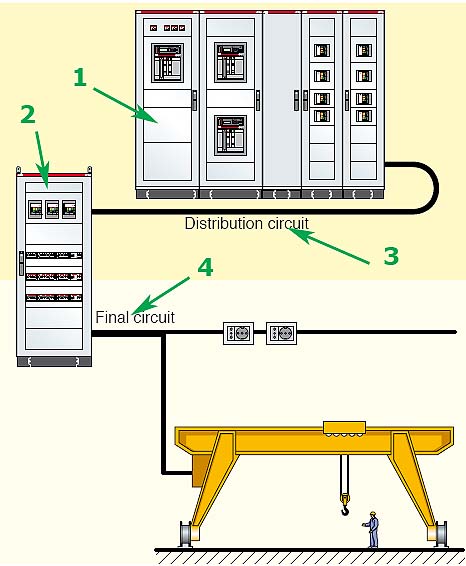
Рис. ABB
1 - Главный распределительный щит (ГРЩ)
2 - Распределительный щит;
3 - Распределительная цепь
4 - Групповая цепь (конечная цепь)Тематики
Синонимы
- групповая сеть
- групповая цепь здания
- групповая электрическая цепь
- конечная цепь
- конечная цепь здания
EN
DE
- Endstromkreis, m
FR
- circuit terminal (de bâtiments), m
Русско-английский словарь нормативно-технической терминологии > групповая цепь
-
6 электроприём
Electrical engineering: current-using equipment -
7 Edison, Thomas Alva
SUBJECT AREA: Architecture and building, Automotive engineering, Electricity, Electronics and information technology, Metallurgy, Photography, film and optics, Public utilities, Recording, Telecommunications[br]b. 11 February 1847 Milan, Ohio, USAd. 18 October 1931 Glenmont[br]American inventor and pioneer electrical developer.[br]He was the son of Samuel Edison, who was in the timber business. His schooling was delayed due to scarlet fever until 1855, when he was 8½ years old, but he was an avid reader. By the age of 14 he had a job as a newsboy on the railway from Port Huron to Detroit, a distance of sixty-three miles (101 km). He worked a fourteen-hour day with a stopover of five hours, which he spent in the Detroit Free Library. He also sold sweets on the train and, later, fruit and vegetables, and was soon making a profit of $20 a week. He then started two stores in Port Huron and used a spare freight car as a laboratory. He added a hand-printing press to produce 400 copies weekly of The Grand Trunk Herald, most of which he compiled and edited himself. He set himself to learn telegraphy from the station agent at Mount Clements, whose son he had saved from being run over by a freight car.At the age of 16 he became a telegraphist at Port Huron. In 1863 he became railway telegraphist at the busy Stratford Junction of the Grand Trunk Railroad, arranging a clock with a notched wheel to give the hourly signal which was to prove that he was awake and at his post! He left hurriedly after failing to hold a train which was nearly involved in a head-on collision. He usually worked the night shift, allowing himself time for experiments during the day. His first invention was an arrangement of two Morse registers so that a high-speed input could be decoded at a slower speed. Moving from place to place he held many positions as a telegraphist. In Boston he invented an automatic vote recorder for Congress and patented it, but the idea was rejected. This was the first of a total of 1180 patents that he was to take out during his lifetime. After six years he resigned from the Western Union Company to devote all his time to invention, his next idea being an improved ticker-tape machine for stockbrokers. He developed a duplex telegraphy system, but this was turned down by the Western Union Company. He then moved to New York.Edison found accommodation in the battery room of Law's Gold Reporting Company, sleeping in the cellar, and there his repair of a broken transmitter marked him as someone of special talents. His superior soon resigned, and he was promoted with a salary of $300 a month. Western Union paid him $40,000 for the sole rights on future improvements on the duplex telegraph, and he moved to Ward Street, Newark, New Jersey, where he employed a gathering of specialist engineers. Within a year, he married one of his employees, Mary Stilwell, when she was only 16: a daughter, Marion, was born in 1872, and two sons, Thomas and William, in 1876 and 1879, respectively.He continued to work on the automatic telegraph, a device to send out messages faster than they could be tapped out by hand: that is, over fifty words per minute or so. An earlier machine by Alexander Bain worked at up to 400 words per minute, but was not good over long distances. Edison agreed to work on improving this feature of Bain's machine for the Automatic Telegraph Company (ATC) for $40,000. He improved it to a working speed of 500 words per minute and ran a test between Washington and New York. Hoping to sell their equipment to the Post Office in Britain, ATC sent Edison to England in 1873 to negotiate. A 500-word message was to be sent from Liverpool to London every half-hour for six hours, followed by tests on 2,200 miles (3,540 km) of cable at Greenwich. Only confused results were obtained due to induction in the cable, which lay coiled in a water tank. Edison returned to New York, where he worked on his quadruplex telegraph system, tests of which proved a success between New York and Albany in December 1874. Unfortunately, simultaneous negotiation with Western Union and ATC resulted in a lawsuit.Alexander Graham Bell was granted a patent for a telephone in March 1876 while Edison was still working on the same idea. His improvements allowed the device to operate over a distance of hundreds of miles instead of only a few miles. Tests were carried out over the 106 miles (170 km) between New York and Philadelphia. Edison applied for a patent on the carbon-button transmitter in April 1877, Western Union agreeing to pay him $6,000 a year for the seventeen-year duration of the patent. In these years he was also working on the development of the electric lamp and on a duplicating machine which would make up to 3,000 copies from a stencil. In 1876–7 he moved from Newark to Menlo Park, twenty-four miles (39 km) from New York on the Pennsylvania Railway, near Elizabeth. He had bought a house there around which he built the premises that would become his "inventions factory". It was there that he began the use of his 200- page pocket notebooks, each of which lasted him about two weeks, so prolific were his ideas. When he died he left 3,400 of them filled with notes and sketches.Late in 1877 he applied for a patent for a phonograph which was granted on 19 February 1878, and by the end of the year he had formed a company to manufacture this totally new product. At the time, Edison saw the device primarily as a business aid rather than for entertainment, rather as a dictating machine. In August 1878 he was granted a British patent. In July 1878 he tried to measure the heat from the solar corona at a solar eclipse viewed from Rawlins, Wyoming, but his "tasimeter" was too sensitive.Probably his greatest achievement was "The Subdivision of the Electric Light" or the "glow bulb". He tried many materials for the filament before settling on carbon. He gave a demonstration of electric light by lighting up Menlo Park and inviting the public. Edison was, of course, faced with the problem of inventing and producing all the ancillaries which go to make up the electrical system of generation and distribution-meters, fuses, insulation, switches, cabling—even generators had to be designed and built; everything was new. He started a number of manufacturing companies to produce the various components needed.In 1881 he built the world's largest generator, which weighed 27 tons, to light 1,200 lamps at the Paris Exhibition. It was later moved to England to be used in the world's first central power station with steam engine drive at Holborn Viaduct, London. In September 1882 he started up his Pearl Street Generating Station in New York, which led to a worldwide increase in the application of electric power, particularly for lighting. At the same time as these developments, he built a 1,300yd (1,190m) electric railway at Menlo Park.On 9 August 1884 his wife died of typhoid. Using his telegraphic skills, he proposed to 19-year-old Mina Miller in Morse code while in the company of others on a train. He married her in February 1885 before buying a new house and estate at West Orange, New Jersey, building a new laboratory not far away in the Orange Valley.Edison used direct current which was limited to around 250 volts. Alternating current was largely developed by George Westinghouse and Nicola Tesla, using transformers to step up the current to a higher voltage for long-distance transmission. The use of AC gradually overtook the Edison DC system.In autumn 1888 he patented a form of cinephotography, the kinetoscope, obtaining film-stock from George Eastman. In 1893 he set up the first film studio, which was pivoted so as to catch the sun, with a hinged roof which could be raised. In 1894 kinetoscope parlours with "peep shows" were starting up in cities all over America. Competition came from the Latham Brothers with a screen-projection machine, which Edison answered with his "Vitascope", shown in New York in 1896. This showed pictures with accompanying sound, but there was some difficulty with synchronization. Edison also experimented with captions at this early date.In 1880 he filed a patent for a magnetic ore separator, the first of nearly sixty. He bought up deposits of low-grade iron ore which had been developed in the north of New Jersey. The process was a commercial success until the discovery of iron-rich ore in Minnesota rendered it uneconomic and uncompetitive. In 1898 cement rock was discovered in New Village, west of West Orange. Edison bought the land and started cement manufacture, using kilns twice the normal length and using half as much fuel to heat them as the normal type of kiln. In 1893 he met Henry Ford, who was building his second car, at an Edison convention. This started him on the development of a battery for an electric car on which he made over 9,000 experiments. In 1903 he sold his patent for wireless telegraphy "for a song" to Guglielmo Marconi.In 1910 Edison designed a prefabricated concrete house. In December 1914 fire destroyed three-quarters of the West Orange plant, but it was at once rebuilt, and with the threat of war Edison started to set up his own plants for making all the chemicals that he had previously been buying from Europe, such as carbolic acid, phenol, benzol, aniline dyes, etc. He was appointed President of the Navy Consulting Board, for whom, he said, he made some forty-five inventions, "but they were pigeonholed, every one of them". Thus did Edison find that the Navy did not take kindly to civilian interference.In 1927 he started the Edison Botanic Research Company, founded with similar investment from Ford and Firestone with the object of finding a substitute for overseas-produced rubber. In the first year he tested no fewer than 3,327 possible plants, in the second year, over 1,400, eventually developing a variety of Golden Rod which grew to 14 ft (4.3 m) in height. However, all this effort and money was wasted, due to the discovery of synthetic rubber.In October 1929 he was present at Henry Ford's opening of his Dearborn Museum to celebrate the fiftieth anniversary of the incandescent lamp, including a replica of the Menlo Park laboratory. He was awarded the Congressional Gold Medal and was elected to the American Academy of Sciences. He died in 1931 at his home, Glenmont; throughout the USA, lights were dimmed temporarily on the day of his funeral.[br]Principal Honours and DistinctionsMember of the American Academy of Sciences. Congressional Gold Medal.Further ReadingM.Josephson, 1951, Edison, Eyre \& Spottiswode.R.W.Clark, 1977, Edison, the Man who Made the Future, Macdonald \& Jane.IMcN -
8 Volk, Magnus
[br]b. 19 October 1851 Brighton, Englandd. 20 May 1937 Brighton, England[br]English pioneer in the use of electric power; built the first electric railway in the British Isles to operate a regular service.[br]Volk was the son of a German immigrant clockmaker and continued the business with his mother after his father died in 1869, although when he married in 1879 his profession was described as "electrician". He installed Brighton's first telephone the same year and in 1880 he installed electric lighting in his own house, using a Siemens Brothers dynamo (see Siemens, Dr Ernst Werner von) driven by a Crossley gas engine. This was probably one of the first half-dozen such installations in Britain. Magnus Volk \& Co. became noted electrical manufacturers and contractors, and, inter alia, installed electric light in Brighton Pavilion in place of gas.By 1883 Volk had moved house. He had kept the dynamo and gas engine used to light his previous house, and he also had available an electric motor from a cancelled order. After approaching the town clerk of Brighton, he was given permission for a limited period to build and operate a 2 ft (61 cm) gauge electric railway along the foreshore. Using the electrical equipment he already had, Volk built the line, a quarter of a mile (400 m) long, in eight weeks. The car was built by a local coachbuilder, with the motor under the seat; electric current at 50 volts was drawn from one running rail and returned through the other.The railway was opened on 4 August 1883. It operated regularly for several months and then, permission to run it having been renewed, it was rebuilt for the 1884 season to 2 ft 9 in. (84 cm) gauge, with improved equipment. Despite storm damage from time to time, Volk's Electric Railway, extended in length, has become an enduring feature of Brighton's sea front. In 1887 Volk made an electric dogcart, and an electric van which he built for the Sultan of Turkey was probably the first motor vehicle built in Britain for export. In 1896 he opened the Brighton \& Rottingdean Seashore Electric Tramroad, with very wide-gauge track laid between the high-and low-tide lines, and a long-legged, multi-wheel car to run upon it, through the water if necessary. This lasted only until 1901, however. Volk subsequently became an early enthusiast for aircraft.[br]Further ReadingC.Volk, 1971, Magnus Volk of Brighton, Chichester: Phillimore (his life and career as described by his son).C.E.Lee, 1979, "The birth of electric traction", Railway Magazine (May).PJGR -
9 Muybridge, Eadweard
SUBJECT AREA: Photography, film and optics[br]b. 9 April 1830 Kingston upon Thames, Englandd. 8 May 1904 Kingston upon Thames, England[br]English photographer and pioneer of sequence photography of movement.[br]He was born Edward Muggeridge, but later changed his name, taking the Saxon spelling of his first name and altering his surname, first to Muygridge and then to Muybridge. He emigrated to America in 1851, working in New York in bookbinding and selling as a commission agent for the London Printing and Publishing Company. Through contact with a New York daguerreotypist, Silas T.Selleck, he acquired an interest in photography that developed after his move to California in 1855. On a visit to England in 1860 he learned the wet-collodion process from a friend, Arthur Brown, and acquired the best photographic equipment available in London before returning to America. In 1867, under his trade pseudonym "Helios", he set out to record the scenery of the Far West with his mobile dark-room, christened "The Flying Studio".His reputation as a photographer of the first rank spread, and he was commissioned to record the survey visit of Major-General Henry W.Halleck to Alaska and also to record the territory through which the Central Pacific Railroad was being constructed. Perhaps because of this latter project, he was approached by the President of the Central Pacific, Leland Stanford, to attempt to photograph a horse trotting at speed. There was a long-standing controversy among racing men as to whether a trotting horse had all four hooves off the ground at any point; Stanford felt that it did, and hoped than an "instantaneous" photograph would settle the matter once and for all. In May 1872 Muybridge photographed the horse "Occident", but without any great success because the current wet-collodion process normally required many seconds, even in a good light, for a good result. In April 1873 he managed to produce some better negatives, in which a recognizable silhouette of the horse showed all four feet above the ground at the same time.Soon after, Muybridge left his young wife, Flora, in San Francisco to go with the army sent to put down the revolt of the Modoc Indians. While he was busy photographing the scenery and the combatants, his wife had an affair with a Major Harry Larkyns. On his return, finding his wife pregnant, he had several confrontations with Larkyns, which culminated in his shooting him dead. At his trial for murder, in February 1875, Muybridge was acquitted by the jury on the grounds of justifiable homicide; he left soon after on a long trip to South America.He again took up his photographic work when he returned to North America and Stanford asked him to take up the action-photography project once more. Using a new shutter design he had developed while on his trip south, and which would operate in as little as 1/1,000 of a second, he obtained more detailed pictures of "Occident" in July 1877. He then devised a new scheme, which Stanford sponsored at his farm at Palo Alto. A 50 ft (15 m) long shed was constructed, containing twelve cameras side by side, and a white background marked off with vertical, numbered lines was set up. Each camera was fitted with Muybridge's highspeed shutter, which was released by an electromagnetic catch. Thin threads stretched across the track were broken by the horse as it moved along, closing spring electrical contacts which released each shutter in turn. Thus, in about half a second, twelve photographs were obtained that showed all the phases of the movement.Although the pictures were still little more than silhouettes, they were very sharp, and sequences published in scientific and photographic journals throughout the world excited considerable attention. By replacing the threads with an electrical commutator device, which allowed the release of the shutters at precise intervals, Muybridge was able to take series of actions by other animals and humans. From 1880 he lectured in America and Europe, projecting his results in motion on the screen with his Zoopraxiscope projector. In August 1883 he received a grant of $40,000 from the University of Pennsylvania to carry on his work there. Using the vastly improved gelatine dry-plate process and new, improved multiple-camera apparatus, during 1884 and 1885 he produced over 100,000 photographs, of which 20,000 were reproduced in Animal Locomotion in 1887. The subjects were animals of all kinds, and human figures, mostly nude, in a wide range of activities. The quality of the photographs was extremely good, and the publication attracted considerable attention and praise.Muybridge returned to England in 1894; his last publications were Animals in Motion (1899) and The Human Figure in Motion (1901). His influence on the world of art was enormous, over-turning the conventional representations of action hitherto used by artists. His work in pioneering the use of sequence photography led to the science of chronophotography developed by Marey and others, and stimulated many inventors, notably Thomas Edison to work which led to the introduction of cinematography in the 1890s.[br]Bibliography1887, Animal Locomotion, Philadelphia.1893, Descriptive Zoopraxography, Pennsylvania. 1899, Animals in Motion, London.1901, The Human Figure in Motion, London.Further Reading1973, Eadweard Muybridge: The Stanford Years, Stanford.G.Hendricks, 1975, Muybridge: The Father of the Motion Picture, New York. R.Haas, 1976, Muybridge: Man in Motion, California.B.Coe, 1992, Muybridge and the Chromophoto-graphers, London.BC -
10 Thomson, Elihu
SUBJECT AREA: Electricity[br]b. 29 March 1853 Manchester, Englandd. 13 March 1937 Swampscott, Massachusetts, USA[br]English (naturalized) American electrical engineer and inventor.[br]Thomson accompanied his parents to Philadelphia in 1858; he received his education at the Central High School there, and afterwards remained as a teacher of chemistry. At this time he constructed several dynamos after studying their design, and was invited by the Franklin Institute to give lectures on the subject. After observing an arc-lighting system operating commercially in Paris in 1878, he collaborated with Edwin J. Houston, a senior colleague at the Central High School, in working out the details of such a system. An automatic regulating device was designed which, by altering the position of the brushes on the dynamo commutator, maintained a constant current irrespective of the number of lamps in use. To overcome the problem of commutation at the high voltages necessary to operate up to forty arc lamps in a series circuit, Thomson contrived a centrifugal blower which suppressed sparking. The resulting system was efficient and reliable with low operating costs. Thomson's invention of the motor meter in 1882 was the first of many such instruments for the measurement of electrical energy. In 1886 he invented electric resistance welding using low-voltage alternating current derived from a transformer of his own design. Thomson's work is recorded in his technical papers and in the 700plus patents granted for his inventions.The American Electric Company, founded to exploit the Thomson patents, later became the Thomson-Houston Company, which was destined to be a leader in the electrical manufacturing industry. They entered the field of electric power in 1887, supplying railway equipment and becoming a major innovator of electric railways. Thomson-Houston and Edison General Electric were consolidated to form General Electric in 1892. Thomson remained associated with this company throughout his career.[br]Principal Honours and DistinctionsChevalier and Officier de la Légion d'honneur 1889. American Academy of Arts and Sciences Rumford Medal 1901. American Institute of Electrical Engineers Edison Medal 1909. Royal Society Hughes Medal 1916. Institution of Electrical Engineers Kelvin Medal 1923, Faraday Medal 1927.Bibliography1934, "Some highlights of electrical history", Electrical Engineering 53:758–67 (autobiography).Further ReadingD.O.Woodbury, 1944, Beloved Scientist, New York (a full biography). H.C.Passer, 1953, The Electrical Manufacturers: 1875–1900, Cambridge, Mass, (describes Thomson's industrial contribution).K.T.Compton, 1940, Biographical Memoirs of Elihu Thomson, Washington, DCovides an abridged list of Thomson's papers and patents).GW -
11 при
•I (α, φ)200 is the intensity of the 200 reflection at a given α and φ.
•The engine develops 340 hp at 1900 rpm.
•For a given centre distance, the length of a crossed belt will be a constant.
•In starting up, the starter should be set at...
•Certain precautions must be taken to obtain satisfactory results in using this equipment.
•On ignition the ingredients must vaporize.
•On interruption of the electric current the valve closes instantly.
•The temperature is read (up)on entering and leaving the water jacket.
•Bentonite shrinks upon drying.
•When added to aluminium, germanium produces a better hardening effect than silicon.
•When employing these compounds as fuel additives, we...
•When tuning a system for optimum performance one must...
•With an overall length of 18 ft the machine weighs 15 tons.
•The compressor operates with one suction valve open.
•Both shot core drilling and rotary drilling methods are used in shaft drilling.
•Given comparable costs for raw materials, the manufacturing cost is determined largely by the weight of the component.
•The breakdown of bias voltage decreases by a few tenths of a millivolt for every °C increase in temperature.
•With the proper combination of resistors and capacitors, the voltage will be...
•With (or In) this method, the amount of material to be removed can be closely controlled.
•Given the extraordinary resolution of the Space Telescope, it is possible to detect...
•The conductance increases linearly with the addition of H+.
•The lower inertia of the cone clutch elements permits rapid reversal with low energy loss.
•In moving through the tube the atoms collide with...
•The potential energy is taken as zero for (or as, or with, or when) a → ∞,...
•The equation is useful comparing diffusion currents from electrodes with different capillary characteristics.
•Neutron stars are apparently born the explosions of supernovas.
•Such a function is real for real z.
Русско-английский научно-технический словарь переводчика > при
-
12 шина (в электротехнике)
шина
Проводник с низким сопротивлением, к которому можно подсоединить несколько отдельных электрических цепей.
Примечание — Термин «шина» не включает в себя геометрическую форму, габариты или размеры проводника.
[ ГОСТ Р 51321. 1-2000 ( МЭК 60439-1-92)]
[ ГОСТ Р МЭК 61439.1-2013]
шина
Конструктивный элемент низковольтного комплектного устройства (НКУ).
Такой конструктивный элемент предназначен для того, чтобы к нему можно было легко присоединить отдельные электрические цепи (другие шины, отдельные проводники). Такие шины могут иметь различную конструкцию, геометрическую форму и размеры.
[Интент]
шинопроводшина
Медная, алюминиевая, реже стальная полоса, служащая для присоединения кабелей электрогенераторов, трансформаторов и т.д. к проводам питающей сети
[Терминологический словарь по строительству на 12 языках (ВНИИИС Госстроя СССР)]
общаяшина
-
[IEV number 151-12-30]
шина
-
[Я.Н.Лугинский, М.С.Фези-Жилинская, Ю.С.Кабиров. Англо-русский словарь по электротехнике и электроэнергетике, Москва]EN
busbar
low-impedance conductor to which several electric circuits can be connected at separate points
NOTE – In many cases, the busbar consists of a bar.
[IEV number 151-12-30]
busbar
An electrical conductor that makes a common connection between several circuits. Sometimes, electrical wire cannot accommodate high-current applications, and electricity must be conducted using a more substantial busbar — a thick bar of solid metal (usually copper or aluminum). Busbars are uninsulated, but are physically supported by insulators. They are used in electrical substations to connect incoming and outgoing transmission lines and transformers; in a power plant to connect the generator and the main transformers; in industry, to feed large amounts of electricity to equipment used in the aluminum smelting process, for example, or to distribute electricity in large buildings
[ABB. Glossary of technical terms. 2010]FR
barre omnibus, f
conducteur de faible impédance auquel peuvent être reliés plusieurs circuits électriques en des points séparés
NOTE – Dans de nombreux cas, une barre omnibus est constituée d’une barre.
[IEV number 151-12-30]
2. Проводник прямоугольного сечения из меди, предназначенный для электротехнических целей
(см. ГОСТ 434-78).
Поставляется в бухтах, а также в полосах длиной не менее 2,5 м; По существу, это просто проволока прямоугольного сечения. В указанном ГОСТе и в технической документации, в которой она применяется, обязательно указываются размеры этой проволоки. Например, "Шина ШММ 8,00х40,00 ГОСТ 434-78"
шина
Пруток прямоугольного сечения, применяемый в электротехнике в качестве проводника тока, изготовляемый прессованием или волочением.
[ ГОСТ 25501-82]Тематики
- НКУ (шкафы, пульты,...)
- заготовки и полуфабрикаты в металлургии
- кабели, провода...
Действия
- расположение шин «на ребро» [ПУЭ]
- расположение шин «плашмя» [ПУЭ]
Сопутствующие термины
- гибкая шина
- жесткая шина [ПУЭ]
- изолированные шины [ПУЭ]
- круглые шины [ПУЭ]
- неизолированные шины [ПУЭ]
- обходные шины [ПУЭ]
- профильные шины [ПУЭ]
- секционные шины [ПУЭ]
- фазная шина [ ГОСТ Р 51321.1-2000]
- четырехполосные шины с расположением полос по сторонам квадрата ("полый пакет") [ПУЭ]
- шина PEN-проводника
- шина для присоединения защитных проводников
- шина нулевого защитного проводника
- шина фазы А (B, C) [ПУЭ]
- шины однофазного тока [ПУЭ]
- шины прямоугольного (круглого, трубчатого, коробчатого) сечения [ПУЭ]
- шины трехфазного тока [ПУЭ]
EN
DE
FR
Русско-английский словарь нормативно-технической терминологии > шина (в электротехнике)
См. также в других словарях:
Current loop — This article is about the electrical signaling schemes. For the oceanic phenomenon, see Loop current. A current loop describes two different electrical signalling schemes. Contents 1 Digital 2 Analog 3 Process control use … Wikipedia
Current transformer — A CT for operation on a 110 kV grid In electrical engineering, a current transformer (CT) is used for measurement of electric currents. Current transformers, together with voltage transformers (VT) (potential transformers (PT)), are known as … Wikipedia
Equipment of the Iranian Army — Iranian Army Structure Iranian Army Order of Battle Personnel … Wikipedia
Equipment of the Indian Army — This is a list of some of the modern historical equipment used by Indian Army. Most of the army equipment is imported, but efforts are being made to manufacture indigenous equipment. About 40 Ordnance Factories under control of Ordnance Factory… … Wikipedia
Equipment of the United States Coast Guard — The United States Coast Guard uses cutters and small boats on the water, and fixed and rotary wing (helicopters) aircraft in the air. They also use a variety of firearms, including handguns, rifles and machine guns.CuttersOriginally, the Coast… … Wikipedia
Modern equipment of the British Army — This article is about weapons and equipment. For details of uniforms and orders of dress, see British Army Uniform. British Army … Wikipedia
Residual-current device — A two pole residual current device A Residual Current Device is a generic term covering both RCCBs and RCBOs. A Residual Current Circuit Breaker (RCCB) is an electrical wiring device that disconnects a circuit whenever it detects that the… … Wikipedia
Alternating current — (green curve). The horizontal axis measures time; the vertical, current or voltage. In alternating current (AC, also ac) the movement of electric charge periodically reverses direction. In direct current (DC, also dc), the flow of electric charge … Wikipedia
High-voltage direct current — HVDC or high voltage, direct current electric power transmission systems contrast with the more common alternating current systems as a means for the bulk transmission of electrical power. The modern form of HVDC transmission uses technology… … Wikipedia
Spider-Man's powers and equipment — The fateful spider bite that gave Peter Parker his powers. Amazing Fantasy #15, art by Steve Ditko. Spider Man s powers, abilities, and equipment are used by Marvel Comics superhero Spider Man in tandem to combat his many foes. He receives most… … Wikipedia
Audio equipment testing — is done to provide consumers with an idea of what they are looking for and to make the process of equipment selection easier. The results are published in specialty electronics magazines, online, and in other media. Many people involved in the… … Wikipedia
